
Carbon Nanotubes vs Carbon Black: Which Conductive Filler Performs Better?
Carbon black is cheap, proven and everywhere, but carbon nanotubes are lighter, smarter, and rapidly gaining ground.


For decades, carbon black, graphite and metal particles have been the standard route to making polymers electrically conductive. They remain widely used today in applications ranging from antistatic packaging and industrial flooring to automotive components and electronics.
But while these conventional fillers are effective, they often require relatively high loading levels to achieve conductivity. This can increase material weight, affect mechanical properties and create processing challenges. As manufacturers continue to seek ways to overcome these limitations, researchers are exploring whether nanomaterials could provide the same electrical performance at much lower concentrations.

By 2009, materials scientists had already demonstrated that carbon nanotubes (CNTs) could offer a compelling alternative. In a landmark review, researchers Werner Bauhofer and János Kovács analysed more than 140 published studies on CNT-polymer composites and showed how nanomaterials could transform naturally insulating polymers into conductive or electrostatic discharge (ESD)-safe materials.
Related articles: 3D Printed Polymers Designed from the Inside Out, How Nanotechnology Is Rewriting Polymer Performance, or Nanocomposite Polymer Creates Ultra-Thin Electromagnetic Shields
Their findings centred on the concept of percolation—the point at which enough conductive particles are present to form a continuous electrical pathway through a material. More than 17 years later, the review remains one of the most widely cited papers in the field and has helped establish the foundation for the manufacture of nanotube-enhanced composites.
But that is not to say that carbon black no longer has its uses.
Carbon Black: The Established Solution
Carbon black has long been the workhorse of conductive polymer formulations.
Its advantages are clear:
- Relatively low cost.
- Global availability.
- Well-established processing methods.
- Extensive industrial experience.
For many commodity applications, carbon black remains the logical choice.
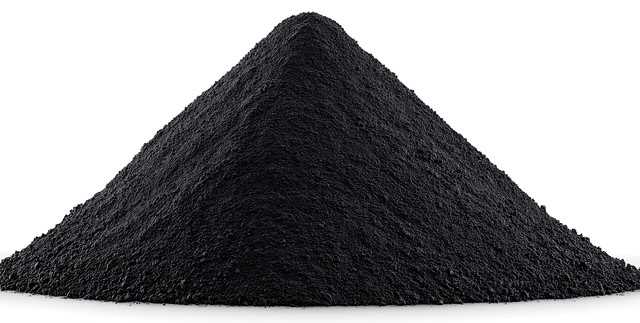
However, there remains a challenge in incorporating carbon black’s relatively small and roughly spherical particles into a polymer to create a conductive network, as manufacturers often need comparatively high loading levels. This can cause increased viscosity, processing complications, and impaired mechanical properties.
These trade-offs can become significant for applications where conductivity is required while still maintaining strength, flexibility, or appearance.
Graphite: Higher Conductivity but Similar Challenges
Graphite fillers offer improved conductivity compared with many grades of carbon black and are frequently used in conductive coatings, batteries and thermal management applications.
However, graphite systems typically still require relatively high loading levels compared with nanotubes, with manufacturers often encountering challenges relating to weight, brittleness, and processability.
Why Carbon Nanotubes Are Different
According to a 2018 review published in Royal Society of Chemistry Advances, the percolation threshold of CNT-polymer composites is exceptionally low because of the nanotubes’ “large aspect ratio”. Thanks to their long, thin cylindrical shape, nanotubes can form highly efficient conductive networks at much lower concentrations.
The Evidence: Ultra-Low Percolation Thresholds
One of the most influential studies in this field was conducted by researchers at the University of Cambridge. In their paper Ultra-Low Electrical Percolation Threshold in Carbon-Nanotube-Epoxy Composites, J.K.W. Sandler and colleagues demonstrated a conductive network forming at approximately 0.0025 wt% CNT loading. Something which the authors described as "the lowest threshold observed" for carbon nanotube-polymer composites at that time.
The significance of this finding extends beyond conductivity, as when less filler is required, manufacturers are able to:
- Preserve more of the polymer's original mechanical properties.
- Reduce weight.
- Improve surface finish.
- Simplify processing.
- Create multifunctional materials.
This is important, because modern manufacturers and their customers are looking for materials that combine conductivity with other enhanced properties, such as mechanical reinforcement, durability, and processability.
But this doesn’t mean that carbon black is obsolete, as it remains a highly effective solution for many applications. Its low cost, broad availability, and extensive manufacturing history ensure it will continue to play a major role in conductive polymers—especially for high-volume products where conductivity requirements are modest and material cost is critical.
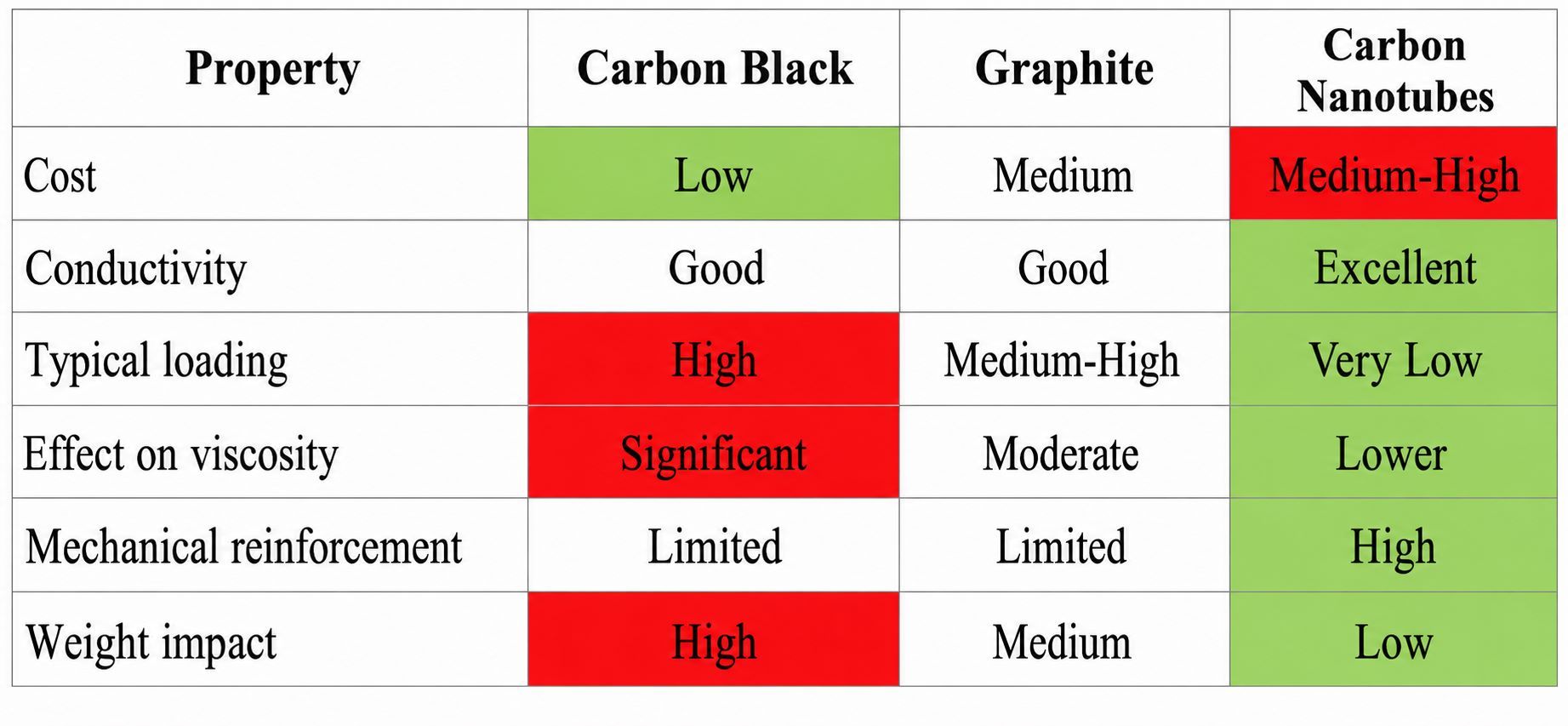
The real opportunity for CNTs lies in applications where manufacturers want conductivity without sacrificing other properties or even in situations where other, added properties are also desired. Depending on formulation and loading levels, nanotechnology can also provide a polymer with scratch resistence, chemical resistence, UV protection, or thermal conductivity.
This ability is changing the conversation among manufacturers away from simply adding conductivity to overall system performance.
For commodity applications, carbon black remains difficult to beat in many ways. However, for manufacturers seeking to reduce filler loading, maintain mechanical performance, and create higher-value products, carbon nanotubes increasingly offer advantages that traditional conductive fillers struggle to match. This means that for companies designing the next generation of conductive polymers, coatings and composites, the most important question may not be which filler is cheapest, but which filler delivers the greatest value across a product’s entire lifecycle.