
A Polymer that Looks Like Glass but Folds 500,000 Times
Nanotechnology has created a scratch-resistant plastic that looks like glass, yet can be folded thousands of times without breaking.

Imagine a plastic that looks and feels like glass, resists scratches like glass, remains highly transparent like glass, yet can be folded thousands of times without breaking.
That sounds like the ideal material for a foldable smartphone and is exactly the application nanotechnology researchers used to demonstrate a new polymer nanocomposite.

Yet the most important aspect of the research is not the smartphone screen itself, as the material is still a long way from becoming a commercial display cover, as touchscreens contain adhesives, coatings, touch layers, manufacturing defects, and countless other factors that affect performance in daily use.
Instead, the real breakthrough lies in how nanotechnology has enabled properties which were traditionally considered incompatible to coexist within a single material. For polymer manufacturers, it is a new reality that is proving far more significant than any individual consumer application.
Product designers constantly make difficult decisions about which properties matter most and which must be sacrificed. The challenge becomes even greater as customer expectations increase, causing manufacturers to be asked to deliver products that are simultaneously stronger, lighter, thinner, more durable, and more sustainable.
Traditional material design often struggles to satisfy all these demands at once.

To avoid material trade-offs, nanotechnology researchers are focusing on how different materials can be combined and organised at the nanoscale.
In this latest case, the resulting polymer nanocomposite consists of a silica-rich network interwoven with polyethylene nanofibres. Individually, neither component offers the full combination of properties demonstrated by the final material, but together, they create a structure that behaves in a fundamentally different way. Creating a material which achieves high optical transparency and glass-like hardness but also demonstrates exceptional resistance to repeated folding and impact.
The basis for the nanocomposite design is a translucent scaffold made from ultrahigh molecular weight polyethylene. Into this rigid structure was placed a liquid mixture of silsesquioxane and nanosilica that could enter the scaffold and cure under ultraviolet light to form a solid network that resembled glass around the fibres.
Typically, harder plastics are covered with a softer laminate, but when bent or folded, the two different structures react differently, leading to misshaping and blemishes. Crucially, this new material is not made up of distinct sheets, as the hard and soft phases penetrate the film, giving it multiple desired properties. This means that hardness, toughness, and strain distribution are all linked to the same internal geometry in the novel film by the silica-rich network that runs through the polyethylene nanofibres.
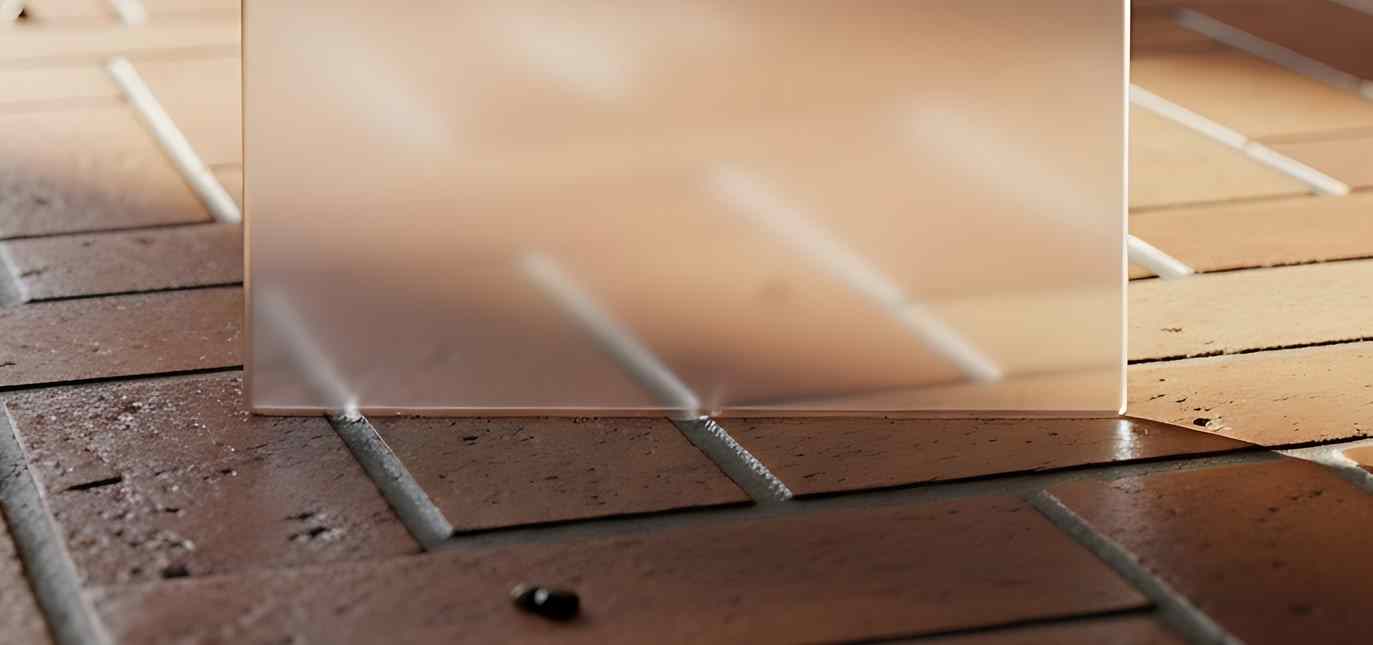
Moreover, transparent polymers given added strength with incorporated particles and fibres often turn cloudy as the additives reflect incoming light. This new nanocomposite also solves this issue, as the silica particles and polymer fibrils stay smaller than visible wavelengths, and the components bend light by almost the same amount.
Consequently, the researchers report, “The resulting film transmits 92% of light at 550 nm with haze below 1%.”
Yet the film still remains reliably flexible, with the study (now published in the journal Advanced Materials) noting that, “When manufactured as thin films (5–30 µm), they can withstand extreme folding cycles (500,000 cycles at a radius of curvature of 0.5 mm) without macroscopic creasing/cracking or microscopic structure/morphology changes.” This is despite the interlocking layers forming a film with a hardness of 1.1 GPa.
Additionally, “The material also resisted setting into a crease while held folded,” with the nanotech journal Nanowerk highlighting how, “The researchers kept the 5 µm film bent at a 0.5 mm radius while exposing it to alternating -20 °C and 80 °C conditions for 144 h. It showed no visible crease or crack. The result supports the proposed mechanism: the rigid hybrid network limits irreversible relaxation, while the nanofibers keep strain from concentrating into damage.”
The polymer also showed exceptional resistance to abrasion, with tests on a colourless polyimide showing scratches after 100 steel wool wear cycles, while the nanocomposite film showed “no clear scratches after 2500 cycles under the reported conditions.”
The film also maintained reasonable transparency and durability when tested under conditions of humidity, heat, ultraviolet light, and solvents, showing minimal signs of ageing and still providing a sufficient barrier against gases and water vapour.

But the most important part of the discovery is not the creation of a flexible, yet sturdy transparent nanopolymer, but the way that carefully engineered nanoscale architectures can allow several desirable characteristics to coexist within one material system. Nanotechnology means that materials no longer need to be defined by a single dominant property, but can provide multiple characteristics and unique selling points.
“The work’s significance lies in treating the glass-plastic compromise as an internal architecture problem,” observes Michael Berger, a nanotechnology expert and author on the development of nanomaterials in industry. “A foldable cover does not have to choose between a hard brittle sheet and a soft creasing film. By interlocking a silica-rich network with polyethylene nanofibers, this glass-like plastic shows how clarity, hardness, impact resistance, and tight-radius foldability can coexist in one thin protective material.”
What This Means For Manufacturers
The significance of this research extends far beyond foldable electronics, as many industrial applications face similar conflicts between competing performance requirements. For example:
- Automotive manufacturers want lighter components without sacrificing durability.
- Medical device producers need materials that combine transparency with toughness.
- Packaging companies seek structures that are flexible, resistant to damage, and provide superior barrier performance against gases and moisture.
- Electronics manufacturers require materials that balance mechanical performance with optical or electrical functionality.
In each case, conventional approaches often force compromises, but with nanotechnology those compromises may not always be necessary.
By controlling material architecture at increasingly small scales, manufacturers can begin designing systems where multiple performance targets are achieved simultaneously.
For manufacturers, this opens opportunities to create multifunctional materials tailored to highly specific application requirements. The challenge then becomes how to realise this potential without the know-how needed to translate laboratory concepts into commercial products.
Thankfully, nanotechnology support is now available through firms like Polymer Nano Centrum who both support this webpage and help manufacturers bridge the gap through expertise in nanocomposites, functional polymers, and advanced material design.
Whether the goal is improving mechanical performance, enhancing electrical or thermal conductivity, increasing durability, adding chemical or scratch resistance, or combining multiple functions within a single material, success increasingly depends on understanding the relationship between nanostructure and performance.
As this latest research demonstrates, the future of polymer innovation may not lie in choosing between competing properties. It lies in designing materials that deliver all of them at once.
Photo credit: Vecteezy, Vecteezy, Vecteezy, Vecteezy, Vecteezy, Vecteezy, & Vecteezy