
Nanotech Unlocks Billion-Dollar Value in Recycled Polymers
How advanced nano-additives are creating valuable solutions and investment opportunities for the circular economy.

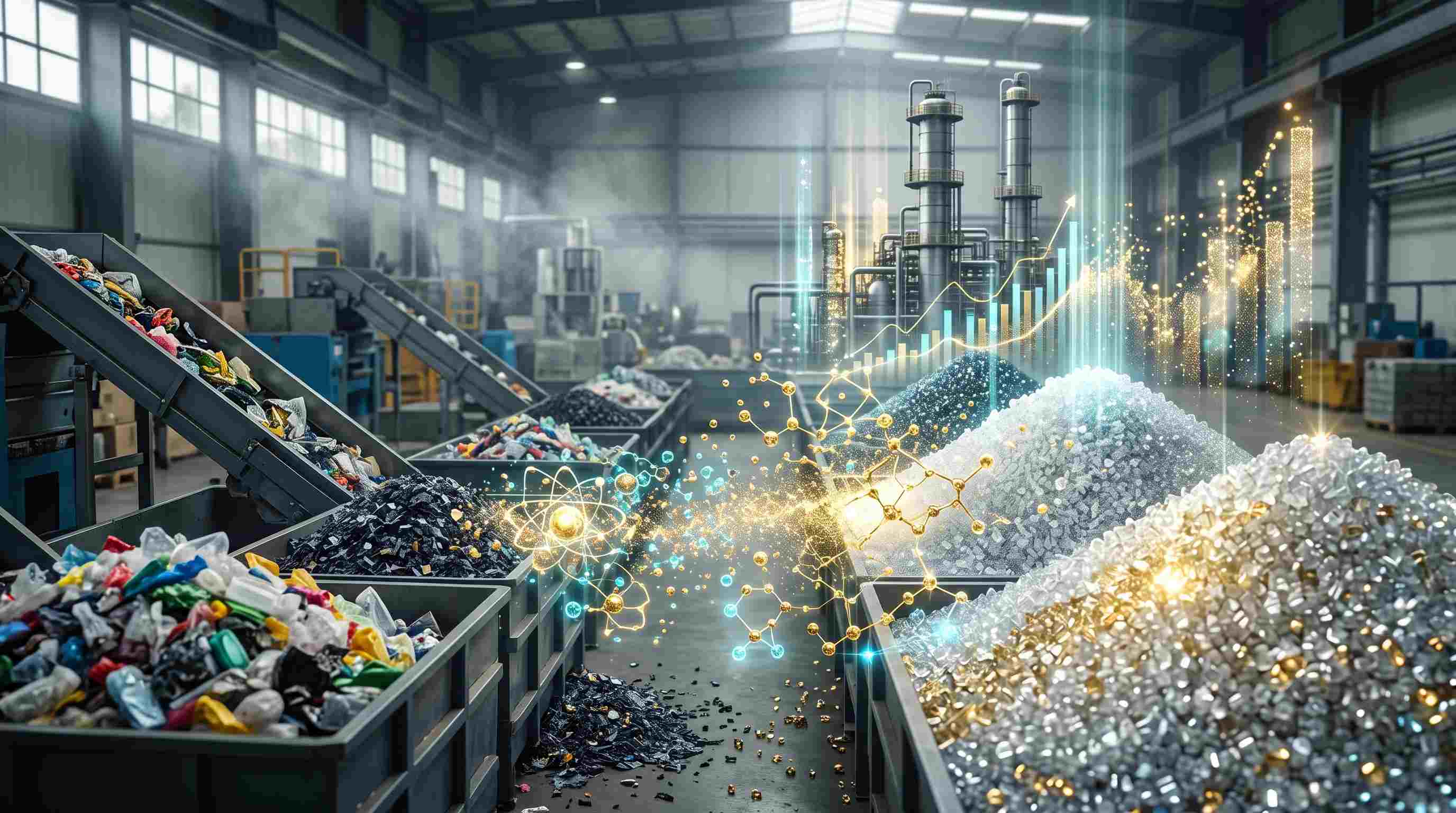
The global push toward sustainability has created unprecedented demand for recycled polymers. However, a major market bottleneck remains: material degradation. Each time plastics undergo mechanical recycling, their physical properties deteriorate, reducing their value and limiting their use in high-performance applications.

For investors and manufacturers, overcoming this degradation gap represents one of the largest growth opportunities in advanced materials. Nanotechnology is providing the breakthrough needed to make high-grade recycled polypropylene commercially viable at scale.
The Market Challenge: The Recycled Polypropylene Bottleneck
Polypropylene (PP) is among the most widely used thermoplastics globally—found in everything from automotive components and consumer packaging to industrial infrastructure.
However, standard recycled PP suffers from compromised strength, lower impact resistance, and unpredictable processing performance. This forces manufacturers to either downcycle the material into low-margin products or rely on costly and environmentally expensive virgin polymers.

While traditional reinforcement methods add weight and production costs, recent advanced material research is finding that ultra-low loadings of nano-fillers can restore a plastic’s performance at a fraction of the cost.
A High-Margin Innovation: Transforming Waste into High-Value Nanomaterials
A groundbreaking study led by researchers at the University of Virginia demonstrates the dual-benefit potential of nanotechnology in recycled plastics:
- Superior Mechanical Enhancement: Combining recycled PP with graphene nanoplatelets yielded a 32% increase in tensile modulus, a 111% increase in elongation at break, and a 109% increase in Izod notched impact strength.
- Unmatched Efficiency: These performance gains were achieved with graphene concentrations of less than 0.1 wt%, keeping raw material costs exceptionally low.
- Dual-Waste Upcycling: The graphene nanoplatelets were derived from spent lithium-ion battery-anode graphite. By converting a hazardous battery waste stream into a valuable performance additive for plastics, the process creates a high-margin, multi-industry circular loop.
From Laboratory Research to Industrial Applications and Investor Value
The prospect of improving recycled polypropylene through nanomodification is relevant to manufacturers looking to incorporate more recovered material without compromising essential performance. It is also a significant clue to investors looking for a financial growth opportunity, as understanding how polymers work at the nanoscale (around one millionth of a millimetre) enables researchers to improve the plastics used in everyday life.

This principle underpins the work Polymer Nano Centrum does in modifying polymers to achieve specific physical and chemical properties. Its research and development activities combine nanostructuring technologies with laboratory equipment to evaluate polymer processing and behaviour. Through this work, the company is able to add value to recycled plastics and help reduce the use of fossil fuels.
“One particularly interesting technical challenge we have worked on is the ageing of polymer materials,” explains one of Polymer Nano Centrum’s researchers. “I find this project very meaningful from an environmental point of view.”
By using nanotechnology to optimise material performance and durability, manufacturers can confidently use more recycled plastics without compromising long-term quality.
“Recycling is very important, but durability is also a key sustainability factor that is sometimes overlooked,” she adds. “If a plastic product lasts longer and keeps its properties over time, it can reduce waste and improve the overall environmental impact of the product.”
The Strategic Outlook for Investors
The research into graphene-enhanced recycled polypropylene highlights an important direction in materials development; manufacturers are looking to use more recycled materials, and nanotechnology is a useful tool to meet that demand. This is especially true in this case, as even the nano-filler is made from a recycled material.
The future value of the polymer sector will be driven not just by recovery rates but by precision engineering. As global regulations tighten around virgin plastic use and carbon emissions, technologies that enhance recycled material performance will capture market share.

Polymer Nano Centrum is actively expanding its R&D and processing capabilities to accelerate the commercialisation of polymer technologies.
Investment Opportunity: Partner with Polymer Nano Centrum
To fund the expansion of its research facilities and accelerate the commercial rollout of its high-performance polymer technologies, Polymer Nano Centrum is offering corporate bonds.
By investing in Polymer Nano Centrum corporate bonds, investors directly finance the scaling of advanced polymer research, which can boost environmental goals. This can enable the company to better support manufacturers in using longer-lasting plastics or in switching to higher-value recycled polymers enhanced with nanomaterials. Given the growth potential of this market, investors can expect the following:
- High-Yield Fixed Income: 10.2% p.a. (paid monthly or yearly)
- Accessible Entry: Minimum investment 100,000 Kč
- Environmental Impact: Direct financing of advanced polymer research
To learn more about the work of this Czech research company and how to invest in corporate bonds, visit Polymer Nano Centrum.
Photo credit: Vecteezy, Gemini, Vecteezy, Vecteezy, Vecteezy, & Polymer Nano Centrum