
On-Demand Biocide for Glass, Plastic and Metal
How a nanomaterial discovery is creating tiny biocide factories on manufactured surfaces.


For many polymer products, antimicrobial performance is no longer a “nice to have” feature. Instead, buyers of healthcare equipment and food packaging, or those who supply public handrails, handles, and high-use surfaces, expect materials that actively reduce contamination while remaining safe, durable, and cost-effective.
For many years now, nanomaterials have made it possible to produce plastics, coatings, and polymer-based sprays with long-lasting antimicrobial properties. However, what is needed in many situations, is a coating which destroys contaminants on demand.
Now a new breakthrough has been made showing how nanotechnology can create biocides which are formed only when microbes are present. Called B-STING (Biocidal Silica-Templated Immobilized Nano-Groups) the discovery could reshape how antimicrobial functionality is built into raw materials.

The study was conducted at the Polish Academy of Sciences in Kracow and is based on the intelligent application of silica-based nanocomposites to produce reactive oxygen species (ROS) on demand. Unlike traditional antimicrobial additives that constantly release active agents, this material stays passive until it detects chemical signals associated with microbial activity. When bacteria or fungi are present, the surface “switches on” and generates short-lived biocides that deactivate the microbes. Once the threat is gone, the activity stops.
"When we use nanoparticles of, say, gold or silver for biocidal purposes, they have to interact directly with microorganisms,” explains Dr. Magdalena Laskowska, the study’s first author. “Our material is the result of a decade of work on a radically different approach [as] it is not in itself a biologically active substance. However, what it is, is a nanofactory that produces reactive oxygen species that are lethal to microorganisms and effectively penetrate the cell membranes of bacteria and fungi.”
The findings, published in Applied Surface Science, show that the new material behaves very differently from conventional nanoparticles, which often degrade or require external activation. The current solution to this is higher additive loadings, which cost more, are wasteful, and incur increasing regulatory scrutiny.
In contrast, this new nanotech coating does not need regeneration and remains effective as long as oxygen and water are present. Additionally, the use of nanoparticles and on-demand activation means lower overall biocide exposure, longer functional lifetimes, and greater sustainability—factors that matter to both regulators and customers. Tests on human fibroblasts have also confirmed that the material is safe for human cells.
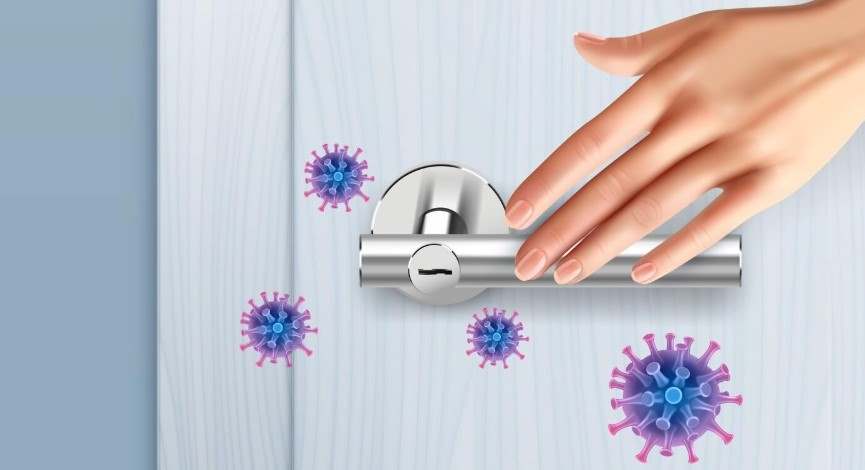
Silica nanocomposites are already widely used as fillers or functional additives, making integration into existing polymer systems easier than many exotic nanomaterials. Furthermore, the research suggests these coatings or additive layers can remain transparent, mechanically stable, and compatible with common processing methods. This makes it likely that the nanotechnology can provide antimicrobial functionality without compromising aesthetics, performance, or major changes to current production facilities.
Related articles: Nanocomposites Create Antimicrobial Coating for Touchscreens or Beetroot-Nanotech for Antimicrobial Action in Polypropylene
Another commercial advantage lies in differentiation. On-demand antimicrobial polymers offer a clear value proposition that can be communicated to end users: protection when it is needed, inactivity when it is not. Another example of how nanotechnology is helping to solve some of manufacturing’s most pressing challenges.
Potential application areas include:
· Medical devices and hospital surfaces where infection control is critical.
· Food-contact plastics and packaging requiring high hygiene standards.
· Public-use components such as handles, switches and transport interiors.
· Consumer products where durability and cleanliness must coexist.
This is a diverse range of products and materials, as the online journal Phys.org reports, “These coatings can be applied to various materials—especially polymers, metals and glass—as well as to objects with complex shapes. In the long term, the lack of a trigger and long-term operation also allow for intrabody applications, in the form of coatings on implants or dental fillings.”
The practical possibilities of such a discovery mean that on-demand biocidal nanocomposites are not just a scientific curiosity but instead represent a tangible opportunity for polymer producers. By providing antimicrobial properties to everyday raw materials, manufacturers can use nanotechnology to improve margins, increase sustainability, meet evolving customer expectations, and gain a competitive edge in hygiene-sensitive markets.
For innovation-driven companies, the key challenge is translating promising laboratory research, such as nanomaterials which provide antimicrobial properties, into commercially viable solutions. This involves optimising dispersion, ensuring processing stability, validating long-term performance, and navigating regulatory requirements. POLYMER NANO CENTRUM, a Prague-based business, plays a critical role in this field by bridging applied research to industrial reality.
By supporting material selection, testing and scale-up, the company (which sponsors this website) helps businesses reduce development risk and bring advanced nanotechnology to polymer products and then to market faster.
Photo credit: wd toro mc on Unsplash, Freepik, & Macrovector